

(Chinhphu.vn) - Hanoi’s 100-year master plan is shaping a new development vision in which “green” is no longer viewed merely as an environmental objective, but as the defining axis of the city’s long-term growth model.With the aspiration of creating a vision of “a forest within the city, and a city embraced by the forest,” Hanoi is steering toward a capital that is not only culturally rich and modern, but also ecologically balanced — a place where sustainable living and an elevated quality of life become integral to the future of its people.
A Grand Vision Requires Long-Term Commitment
One of the most ambitious highlights of Hanoi’s master plan is the goal of increasing green space to account for 40–50% of the city’s natural land area. In the context of rapid urbanization and mounting development pressure, this is widely regarded as a bold and forward-looking target.
According to Architect Pham Anh Tuan, Head of the Landscape Architecture Division at the Faculty of Architecture and Planning, Hanoi University of Civil Engineering, achieving this ratio would mark a transformative leap in the city’s living environment. Green spaces would not only help improve the urban microclimate and reduce flooding risks, but also create valuable land reserves for future generations.
However, he also emphasized the importance of properly understanding the concept of “green land” within urban planning. The term primarily refers to public green spaces, rather than agricultural or aquaculture land. This underscores the scale of the challenge ahead, especially given that Hanoi’s current green-space ratio stands at only around 2 square meters per person — far below the proposed target.
For that reason, Architect Pham Anh Tuan noted that realizing this vision cannot be achieved in the short term. It requires a long-term roadmap sustained across multiple phases of urban development. More importantly, the planning strategy must remain consistent through generations, backed by steadfast commitment and strong public consensus.
Turning Vision into Reality Through Integrated Solutions
To bring its long-term vision to life, Hanoi is rolling out a wide range of synchronized initiatives — from removing barriers around public parks and revitalizing flower gardens to developing retention lakes and expanding public spaces. These efforts go beyond urban beautification; they represent strategic steps toward shaping a greener and more sustainable urban framework for the future.
According to Mr. Nguyen Manh Hung, Head of the Underground Space, Greenery and Lighting Management Division under the Hanoi Department of Construction, the city’s overarching vision is to create a model of “A Forest Within the City – A City Within the Forest,” where green landscapes and water surfaces serve as the central pillars of urban planning and development.
At present, Hanoi is accelerating numerous projects focused on lake restoration, public-space enhancement, and the expansion of pedestrian streets. These initiatives are expected to increase green coverage, improve living conditions, and help regulate the urban climate in a more sustainable way.
However, experts emphasize that for the master plan to be truly feasible, it must be grounded in the practical realities of each area — including economic capacity, development needs, and demographic characteristics. Comprehensive site surveys and data-driven assessments therefore play a pivotal role in ensuring that planning strategies align closely with real-world conditions.
Equally important is public consensus. Architect Pham Anh Tuan noted that when urban planning reflects the genuine needs and aspirations of residents, it is far more likely to gain widespread support and long-term cooperation throughout the implementation process. Without that collective alignment, execution may face significant challenges.
Another indispensable factor is financial capacity. To realize large-scale urban projects, Hanoi will need to strengthen the mobilization of social investment resources, particularly through public–private partnership (PPP) models, thereby enhancing both the feasibility and long-term sustainability of its development plans.
Green Transformation – The Driving Force Behind Urban Restructuring
Hanoi’s 100-year master plan extends far beyond the creation of green spaces. At its core lies a broader ambition: to drive a comprehensive green transformation across the economy and every aspect of urban life.
According to Mr. Luu Quang Huy, Director of the Hanoi Institute for Urban and Rural Planning, the master plan envisions the Capital’s development as rapid, sustainable, and inclusive — closely aligned with digital transformation, green transition, and the principles of a circular economy.
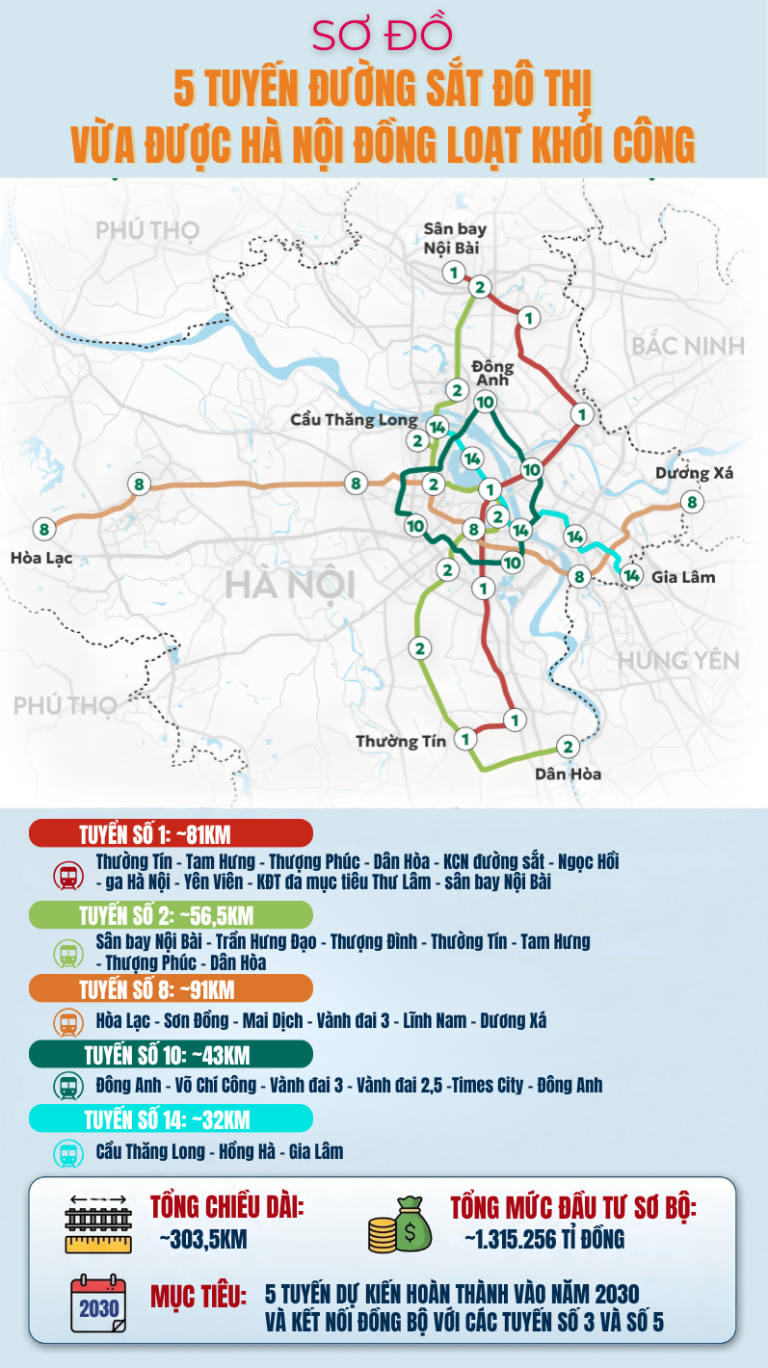
Within this vision, transportation is identified as one of the most critical breakthrough sectors. The plan introduces additional interregional transport corridors, strategic growth axes, ring roads, and major urban hubs aimed at reshaping Hanoi’s future development landscape. In particular, areas surrounding metro stations will be developed under a compact urban model, helping optimize land use while freeing up more space for greenery and public landscapes.
The city has set ambitious targets for public transportation, aiming for it to account for 50% of total travel demand by 2045 and 60–65% by 2065. At the same time, Hanoi plans to transition 100% of buses and taxis to green energy while establishing low-emission zones across the inner city.
Beyond transportation, the green transition is also accelerating across the energy and industrial sectors. Hanoi is prioritizing renewable energy development, promoting energy efficiency, and requiring new industrial zones to adopt environmentally responsible technologies. Polluting facilities will gradually be relocated or required to upgrade to cleaner production technologies.
Clearly, green transformation is not merely an environmental agenda. It represents a fundamental shift in the city’s growth model — moving away from resource-dependent expansion toward a future driven by technology, innovation, and the efficient use of resources.
Green Urban Construction – Expanding Ecosystem Spaces
Over the long term, the most profound transformations are expected to take place within the fields of construction and urban development. Hanoi’s master plan envisions an expanded network of green spaces, the widespread development of green buildings, the adoption of environmentally friendly materials, and a significant reduction in carbon emissions throughout the entire lifecycle of each project.
Mr. Nguyen Trong Ky Anh, Director of the Hanoi Department of Planning and Architecture, emphasized that one of the plan’s most groundbreaking shifts lies in moving from “passive renovation” toward “value-driven urban regeneration” through a “compact yet green” development model. Under this approach, building density will be reduced while height limits are strategically increased, allowing more ground space to be dedicated to greenery, public parks, and water features.
Within future urban developments, standards such as energy efficiency, renewable energy integration, water recycling, and expanded green coverage will no longer be optional — they will become mandatory requirements. Future urban models are expected to go beyond merely providing housing, instead integrating social infrastructure, environmental systems, and ecological spaces into a unified and sustainable living ecosystem.
At the same time, circular economy principles will be strongly promoted across the construction sector through material recycling, reduced energy consumption, and lower emissions. Once implemented on a broader scale, this model is expected to significantly reduce waste generation while conserving valuable natural resources.
Notably, the master plan also places strong emphasis on protecting the city’s rivers, lakes, forests, and green corridors. Green belts and ecological wedges are designed not only to enhance the urban landscape, but also to regulate the climate, mitigate flooding, and improve overall quality of life.
Beyond the urban core, rural areas are likewise being guided toward ecological agriculture, high-tech farming, and circular economic models closely tied to eco-tourism and sustainable production.
Taken as a whole, Hanoi’s 100-year master plan is not simply about expanding the city’s physical scale. It represents a long-term vision for balanced development between people and nature — where built environments and ecological systems do not compete, but instead complement one another to create a harmonious, sustainable, and highly livable capital. Through this vision, Hanoi is steadily moving closer to its aspiration of becoming a green, modern, and truly livable metropolis for future generations.
Source: thanglong.chinhphu.vn

 0853 58 79 79
